






Frequently Asked Questions
We have the answers you're looking for
TMS therapy at Moment of Clarity treats a range of mental health disorders with varying levels of FDA approval and clinical evidence. Major depressive disorder in adults who have not responded adequately to antidepressant medication was TMS's first FDA-approved indication, received in 2008, and remains its most established application. OCD in adults received FDA approval in 2018, specifically using deep TMS protocols targeting the anterior cingulate cortex and medial prefrontal cortex. Smoking cessation and migraine prevention are also FDA-approved TMS applications. Anxious depression, the co-occurrence of major depression and significant anxiety, received an FDA approval in 2021. Off-label applications with growing clinical support include PTSD, generalized anxiety disorder, panic disorder, bipolar depression, and certain presentations of schizophrenia-related negative symptoms. The specific protocol, device type, and coil placement used by Moment of Clarity varies based on the patient's diagnosis to ensure stimulation is directed to the brain regions most relevant to each condition. Call 949-625-0564 to discuss your diagnosis and TMS candidacy.
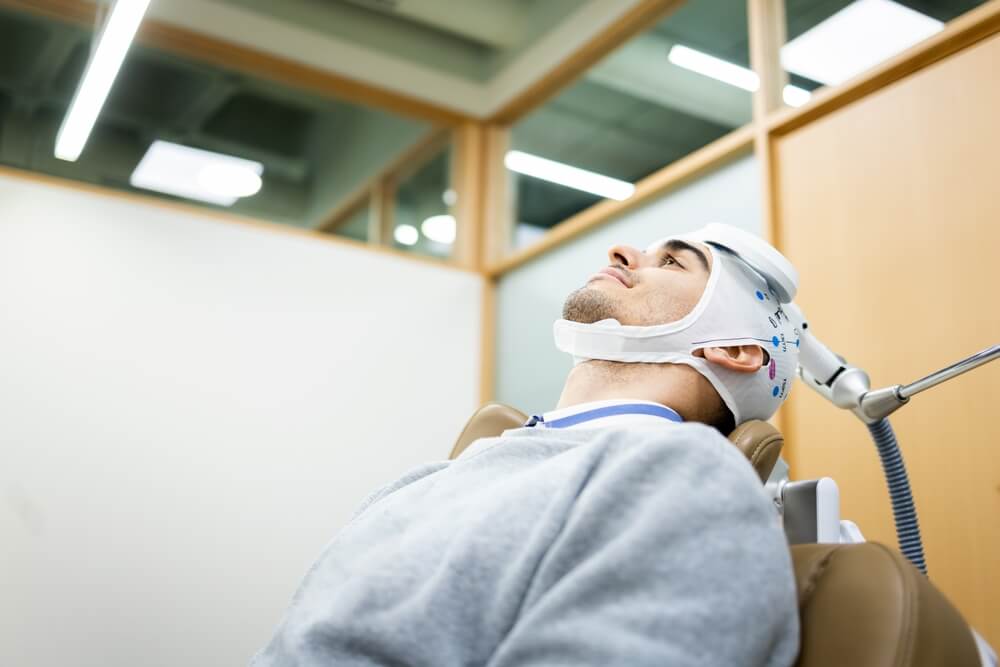
TMS stimulates the brain to improve mental health by delivering focused electromagnetic pulses through the skull to activate neurons in targeted cortical regions without surgery, anesthesia, or systemic side effects. For depression, TMS targets the left dorsolateral prefrontal cortex, which is underactive in people with major depressive disorder, and applies repetitive pulse trains that depolarize neurons and trigger downstream effects throughout the cortico-limbic circuits involved in mood regulation, motivation, and emotional control. The repeated daily stimulation across a treatment course promotes neuroplasticity through several mechanisms: increased synaptic strength through long-term potentiation, enhanced BDNF release supporting neuronal growth and new synapse formation, normalized neurotransmitter activity in targeted regions, and reduced cortical inhibition that allows underactive circuits to resume healthier firing patterns. These neuroplastic changes accumulate over the course of treatment and persist after it ends, producing antidepressant and mood-stabilizing effects that can last for months. For OCD, the stimulation targets different brain regions associated with the compulsive neural loops, using a different protocol designed to disrupt rather than activate the targeted circuits.
TMS is specifically developed and FDA-approved for treatment-resistant depression, defined as major depressive disorder in which the patient has not responded adequately to antidepressant medication, and its evidence base is strongest in this population. Research consistently shows response rates of 50 to 60% and remission rates of approximately 30 to 35% in treatment-resistant patients, with a 2024 study in PNAS finding that almost 80% of patients treated with TMS for depression reached remission using optimized protocols. Because TMS works through the glutamate and neuroplasticity pathways rather than the serotonin systems targeted by antidepressants, prior medication failure does not predict TMS failure, and the two treatments do not compete on the same neurochemical territory. The FDA-approved indication for treatment-resistant depression also makes TMS one of the most reimbursable advanced psychiatric treatments for this population, with most major insurers covering it for qualifying patients. If you have not responded to antidepressant medications, TMS is one of the most evidence-based next steps available.
TMS and ketamine therapy can be combined in appropriate patients at Moment of Clarity, and some emerging research suggests that these two treatments may produce synergistic benefits when sequenced or overlapping because they promote neuroplasticity through complementary mechanisms. Ketamine provides rapid antidepressant effects through glutamate pathway blockade and synaptogenesis, creating a neuroplastically primed brain state within hours to days. TMS adds sustained prefrontal stimulation that can build on and extend the neural changes ketamine initiates across a course of daily sessions. Some researchers hypothesize that the neuroplastic window opened by ketamine may specifically enhance the brain's responsiveness to TMS-induced changes, though direct evidence for this interaction in well-controlled trials is still developing. At Moment of Clarity, both TMS and ketamine therapy including Spravato are available within the same clinical program, making combined approaches accessible under coordinated clinical supervision. The decision to combine treatments is always based on a thorough individual evaluation. Call 949-625-0564 to discuss whether a combined approach is appropriate for you.
The scientific basis for TMS in mental health treatment is grounded in more than 30 years of research beginning with its development as a research tool for studying brain function in the 1980s and expanding through clinical trials that established its efficacy and safety across multiple conditions. The mechanism of TMS action involves the principle of electromagnetic induction, through which a time-varying magnetic field generates electrical currents in cortical tissue, causing neurons to depolarize and fire in a controlled, repeatable pattern. This neuronal activation triggers downstream changes including BDNF release, long-term potentiation, normalized neurotransmitter release, and reduced cortical inhibition in targeted circuits. Multiple large-scale randomized controlled trials, including the landmark OPT-TMS study, the NeuroStar multicenter trial, and subsequent real-world effectiveness studies, have established that TMS produces clinically and statistically significant improvements in depression compared to sham stimulation. Neuroimaging studies have shown that TMS produces measurable changes in blood flow and metabolic activity in targeted and connected brain regions, providing biological evidence of the treatment's mechanism of action. These findings collectively justify TMS's FDA-approved status for multiple indications.
TMS therapy for mental health and TMS for migraines use the same fundamental technology of electromagnetic stimulation but differ in the specific devices used, the stimulation parameters, the targeted brain regions, and the clinical indications that guide their use. For mental health conditions including depression and OCD, TMS uses repetitive TMS protocols with specific pulse trains delivered to the prefrontal cortex over daily sessions across several weeks, promoting neuroplasticity and restoring healthy mood-regulating circuit function. For acute migraine treatment, single-pulse TMS devices deliver one or two high-intensity pulses to the occipital cortex, which is the brain region involved in migraine pathophysiology, providing rapid interruption of the cortical spreading depression that underlies migraine with aura. For migraine prevention, repetitive TMS protocols targeting either the occipital or prefrontal cortex may be used over a course of sessions to reduce migraine frequency. The FDA has separately approved devices for each of these indications, and the clinical evaluation for migraine TMS involves assessment of headache history and neurology rather than psychiatric history. Moment of Clarity's TMS program focuses on mental health applications.
TMS protocol selection for anxiety at Moment of Clarity depends on whether anxiety is the primary diagnosis or is co-occurring with depression, as the optimal approach differs between these presentations. For anxious depression, the FDA has approved TMS at parameters specifically studied for this co-occurring presentation, and the standard left-sided high-frequency protocol with specific pulse parameters is used. For anxiety disorders without co-occurring depression, including generalized anxiety disorder, right-sided low-frequency or inhibitory TMS protocols are sometimes used to reduce overactivity in the right prefrontal circuits that contribute to excessive worry and rumination, while bilateral or left-sided activating protocols are also studied. For PTSD, TMS targeting both the left prefrontal cortex and the right prefrontal cortex in inhibitory fashion to reduce fear circuit overactivity has been studied in veteran populations with meaningful results. Your clinician at Moment of Clarity will select the protocol most appropriate for your specific anxiety presentation, diagnosis history, and prior treatments during the intake evaluation. Call 949-625-0564 to discuss anxiety-specific TMS protocols.
TMS therapy does not cause harmful permanent brain changes, and the neuroplastic changes it produces are a restoration of healthier function rather than an external alteration of the brain's structural character. Repeated TMS stimulation promotes the same types of activity-dependent neuroplasticity that healthy brains engage in through learning and experience, including long-term potentiation of synaptic connections, neuronal growth supported by BDNF, and restoration of more efficient neural pathway communication. These changes are beneficial and reflect the brain returning toward a healthier functional state rather than being permanently modified in an artificial direction. Neuroimaging studies after TMS treatment show changes in cerebral blood flow and metabolic activity in targeted regions consistent with restored prefrontal function, not with structural damage. No evidence from more than 30 years of TMS research has identified long-term harmful structural changes to brain tissue from therapeutic TMS at standard clinical parameters. The FDA approval process specifically evaluated long-term safety data before granting clearance for each indication, and no long-term neurological risks have been identified.
Accelerated TMS, also called iTBS or Intermittent Theta Burst Stimulation at high delivery rates, refers to protocols that compress the standard TMS treatment course from four to six weeks of daily sessions into a much shorter timeframe, sometimes delivering multiple sessions per day over a week or two to achieve faster results. Stanford Accelerated Intelligent Neuromodulation Therapy (SAINT), a particularly well-publicized accelerated TMS protocol, achieved remission rates above 70% in published trials using 10 sessions per day across 5 days. These accelerated protocols represent a clinically significant advance for patients who cannot maintain a standard daily schedule over several weeks or who need faster results than standard TMS timelines provide. The availability of accelerated TMS at Moment of Clarity depends on the specific devices and clinical protocols in use at the time of your evaluation; this is a developing area of clinical practice and protocol availability evolves. During your clinical evaluation, the Moment of Clarity team will discuss which TMS protocols are available and most appropriate for your specific situation. Call 949-625-0564 for current protocol information.
Determining whether TMS is right for your mental health disorder at Moment of Clarity involves a comprehensive clinical evaluation that reviews your diagnosis, symptom severity and duration, prior treatment history, current medications, and any potential contraindications. TMS is most clearly appropriate for adults with major depressive disorder who have not responded to at least one antidepressant, and for adults with OCD who have not responded adequately to CBT and SSRI medication. For other conditions including PTSD, anxiety, and bipolar depression, the evaluation includes a discussion of the current evidence base for TMS in your specific presentation and a comparison with other available treatment options. The presence of metal implants near the head, history of seizures, and certain medical conditions may affect eligibility. Insurers' coverage criteria provide another framework: if you meet the medical necessity criteria for TMS coverage under your plan, that is a strong signal that TMS is clinically appropriate. The free consultation at 949-625-0564 is the first step toward finding out whether TMS is the right next step for your situation.
